
Find out what happens during a B&W Feeds mobile mill-and-mix visit, from planning the ration and farm access to milling, mixing and finished feed.
Kathryn Thompson :: Monday 21st September 2026 :: Latest Blog Posts
What Happens During a Mobile Mill-and-Mix Visit?
Mobile mill-and-mix gives suitable livestock farms a way to process their own cereals and pulses without operating a permanent feed mill.
A specialist B&W Feeds vehicle visits the farm, processes the agreed home-grown ingredients and incorporates complementary feeds according to the planned ration.
For farmers who have never used the service, however, the practical side can be less obvious.
What information does B&W Feeds need before the first visit? How does the farm need to prepare? What happens when the vehicle arrives? And where does the finished feed go afterwards?
Every farm is different, but a typical mobile mill-and-mix visit follows a clear process.
It Starts With a Conversation
The first stage happens well before a mobile mill is scheduled to arrive.
B&W Feeds needs enough information to understand the farm, the livestock and whether mobile milling is likely to be a practical option.
Useful information includes:
- The farm postcode.
- Livestock species and approximate numbers.
- Whether the system is organic or conventional.
- Home-grown cereals or pulses available.
- Approximate feed volumes.
- Current forage and feeding approach.
- The main nutritional or practical objective.
- Storage and access arrangements.
This helps the team assess current route availability as well as the suitability of the service itself.
Mobile mill-and-mix is not a standard solution that is applied in exactly the same way on every farm.
A mixed arable and livestock business looking to use its own barley for finishing cattle will have different requirements from a dairy farm, pig enterprise, sheep business or commercial poultry unit.
The crops available, livestock requirements, feed quantities and frequency of visits all need to be considered.
Reviewing the Ration
Home-grown cereals and pulses can provide a useful foundation for livestock feed, but they do not automatically create a complete ration.
Depending on the livestock, forage and production stage, the ration may also require complementary ingredients such as:
- Protein sources.
- Minerals and trace elements.
- Oils.
- Fibre sources.
- Supplements or specialist products.
Where relevant, forage analysis can also provide useful information about the feed resources already available on the farm.
B&W Feeds can provide ration formulation and nutritional support to mobile mill-and-mix customers, helping to identify how home-grown crops and complementary ingredients can fit together within the wider feeding plan.
The objective is not simply to use as much home-grown grain as possible.
It is to make appropriate use of the resources available on the farm within a ration designed around the livestock.
Agreeing the Practical Arrangements
A suitable ration is only one part of a successful mobile milling visit.
The vehicle also needs to be able to reach the ingredients, operate safely and discharge the finished feed into an appropriate location.
Before the first visit, it is useful to discuss:
- Safe vehicle access.
- The location and condition of grain storage.
- How cereals or pulses will be drawn from storage.
- Space for the mobile mill to position and operate.
- Width or overhead restrictions.
- Where the finished feed will be discharged.
- How the finished feed will be protected from moisture and contamination.
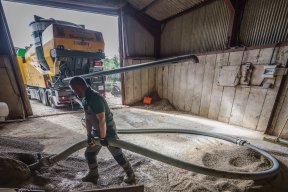
Depending on the farm and the agreed arrangements, finished feed may be discharged into a feed bin, tote bag, trailer or suitable floor or storage area.
Working through these details in advance makes the visit more straightforward and helps avoid practical problems once the vehicle is already on farm.
Arrival and Set-Up
When the mobile mill arrives, the operator positions the vehicle according to the arrangements already discussed with the farm.
The exact set-up varies because no two yards, grain stores or feeding systems are identical.
The operator needs practical access to the agreed ingredients and a clear route for the finished feed to reach its storage or discharge point.
Mobile milling is therefore not simply a case of arriving and processing whatever grain happens to be available.
The visit should follow the agreed ration and use the identified ingredients.
Milling the Farm's Cereals and Pulses
The farm's agreed cereals or pulses are drawn into the mobile mill and processed on site.
For suitable farms, this creates a direct link between crops produced by the business and feed used within the livestock enterprise.
It can also avoid the need for suitable grain to leave the farm purely for processing before returning as part of a finished feed.
How the crop is processed depends on the livestock and the intended ration.
The required feed structure should support the feeding system rather than simply being chosen according to a general preference for a finer or coarser product.
Adding Complementary Ingredients
As the home-grown crops are processed, the other ingredients required by the agreed ration can be incorporated.
These will vary considerably between farms.
A ration for dairy cattle will not be identical to feed for beef finishers, pigs, sheep or commercial poultry. Different livestock groups and production stages can also have different requirements within the same farm.
This is why the planning stage matters.
Mobile mill-and-mix is not simply about combining whatever ingredients happen to be available. It is about using farm-grown crops alongside the appropriate complementary ingredients to produce feed suited to the wider ration.
Mixing the Finished Feed
Once the ingredients have been brought together, they are mixed to produce the finished feed.
Weighing, processing and mixing the ingredients according to the agreed formulation helps ensure the batch is produced consistently.
The operator's job therefore extends well beyond driving the mobile mill between farms.
Each visit involves managing the machinery, following the agreed process and working around the practical conditions of the individual farm.
Discharging and Storing the Feed
Once the ration has been mixed, the finished feed is discharged into the location agreed before the visit.
The farm needs sufficient suitable storage for the planned batch and should be able to protect the feed from moisture, contamination and unnecessary losses.
Storage should also work practically with the normal feeding system.
Producing a suitable ration is only part of the process. If the finished feed then has to be repeatedly moved around the farm or stored somewhere inconvenient, unnecessary work is being added to the system.
Good preparation therefore considers both ends of the mobile milling process:
How will the ingredients reach the mill, and how will the finished feed reach the livestock?
Records and Traceability
One advantage of processing home-grown ingredients on farm is greater visibility over what has gone into the feed.
The farmer knows which cereals or pulses have been used and which complementary ingredients have been incorporated into the agreed ration.
Relevant feed records, traceability requirements and assurance rules still apply, particularly for organic systems or farms with specialist requirements.
These should form part of the wider discussion when the service is being planned.
Planning Future Visits
For regular customers, mobile mill-and-mix can become part of the normal farm feeding routine.
That does not mean every visit should automatically repeat the previous one without review.
Circumstances can change.
Future batches may need to reflect:
- Changes in livestock numbers.
- Animals moving between growing, finishing or production stages.
- Updated forage analysis.
- Different cereals or pulses becoming available.
- Changes between housing and turnout.
- Ingredient availability.
- Changes in the rate at which feed is being used.
If something has changed, it is useful to discuss it before the next visit rather than assuming the previous ration and quantity should simply be repeated.
Is Mobile Mill-and-Mix Suitable for Every Farm?
No.
Mobile milling depends on a combination of practical, nutritional and commercial factors.
These include:
- Location and current route availability.
- Suitable crops being available.
- Feed quantities.
- Vehicle access.
- Raw-material and finished-feed storage.
- Livestock requirements.
- The wider feeding system.
Some farms may be better served by a pre-mixed feed or a combination of bought-in products and home-grown ingredients.
Larger businesses with sufficient scale and long-term feed-production requirements may instead want to explore a permanent static milling and mixing system.
The purpose of the first conversation with B&W Feeds is not to assume mobile milling is automatically the answer.
It is to establish whether it is a practical fit for the individual farm.
What Should You Have Ready Before Enquiring?
If you are considering mobile mill-and-mix, having a few basic details ready will help B&W Feeds give you a more useful initial answer.
Try to provide:
- Your farm postcode.
- Livestock species and approximate numbers.
- Home-grown cereals or pulses available.
- Approximate quantities and feed requirements.
- Organic or conventional status.
- Current forage information, where relevant.
- Storage and discharge arrangements.
- Any important access restrictions.
- The main issue or objective you want the feeding system to address.
From there, the B&W Feeds team can discuss current route availability and whether mobile mill-and-mix is likely to suit your farm.
Considering mobile mill-and-mix?
Send B&W Feeds your postcode, livestock type, home-grown crops and approximate feed requirement and the team can assess current route availability and discuss whether the service could be appropriate for your system.