Considering a permanent on-farm feed mill? Review feed volumes, ingredients, buildings, labour, automation and future requirements before investing.
Kathryn Thompson :: Monday 9th November 2026 :: Latest Blog Posts
When Does a Permanent On-Farm Feed Mill Make Sense? 8 Questions Before Investing
For some livestock businesses, producing feed through a permanent on-farm milling and mixing system can become a logical part of their long-term plans.
For others, it would add cost, infrastructure and management when a mobile mill-and-mix service or bought-in feed remains far more practical.
The important point is that a static feed mill should not be viewed simply as the next step after using more home-grown grain.
It is a significant capital project that needs to fit the scale, infrastructure, labour and future direction of the farming business.
So what should you consider before exploring one?
1. How much feed do you actually need to produce?
Start with throughput rather than machinery.
How much feed does the business use over a full year? Is demand relatively consistent, or highly seasonal? How many different livestock groups and rations are involved?
The relevant figure is not simply the maximum quantity you might produce on a busy day. You need to understand the normal operating requirement over time.
For example, consider:
- annual feed use;
- likely weekly or monthly production;
- seasonal peaks;
- the number of different rations required;
- livestock expansion plans; and
- whether feed production is likely to increase or decrease over the life of the system.
A permanent mill needs enough work to justify the investment, while also being sized sensibly for the business rather than around an unlikely maximum requirement.
2. Which ingredients will you be processing?
A static feed system has to be designed around the ingredients that will actually move through it.
For a mixed arable and livestock farm, that may include home-grown cereals or pulses alongside bought-in complementary ingredients.
Other businesses may require more extensive storage and dosing arrangements for several raw materials, minerals or micro-ingredients.
This affects far more than the mill itself.
The project may need to consider how ingredients are:
- received;
- stored;
- transferred;
- weighed;
- milled or otherwise processed;
- dosed;
- mixed; and
- moved into finished-feed storage.
Before discussing equipment, it is therefore useful to map the journey of each important ingredient through the farm.
3. What are you trying to improve?
Buying machinery before defining the objective makes it much harder to judge whether the investment is worthwhile.
Ask what problem the proposed system is intended to solve.
Is the aim to make regular use of crops already grown by the business?
Do you want greater control over when feed is produced?
Are you trying to integrate existing grain storage with livestock feeding?
Does the business need greater production capacity?
Would automation help reduce routine manual handling?
Or is a wider change in the livestock enterprise creating a new requirement for feed production?
There may be several reasons, but they should be clear.
A permanent feed mill should be designed around a business requirement rather than the business finding work for a piece of machinery after it has been installed.
4. What infrastructure is already available?
The existing farm can have a major influence on the eventual design.
Some businesses may already have suitable grain stores, silos, conveyors or buildings that can form part of the system.
Others may require significant additional infrastructure.
Consider:
- raw-material storage;
- existing silos;
- suitable buildings;
- power requirements;
- access for bulk ingredients;
- transfer between different parts of the system;
- finished-feed storage;
- access for maintenance; and
- how finished feed will reach the livestock.
An installation should work as part of the farm rather than as an isolated collection of equipment.
That is why site layout matters early in the planning process.
5. How much automation is appropriate?
Automation can play a significant role in a modern milling and mixing system, but the right level will depend on the individual business.
Options may include automated ingredient transfer, weighing, dosing, mixing and recipe control.
For a business producing feed regularly, automation may reduce some routine handling and make it easier to repeat established production processes.
But more automation also means that the system needs to be planned, operated and maintained appropriately.
The question should therefore not be, "How automated can we make it?"
It should be, "Which parts of this process would benefit from automation on this particular farm?"
Labour availability, production frequency, the number of recipes and the way feed needs to move around the site will all influence the answer.
6. Who will operate and manage the system?
Owning a permanent feed mill means taking responsibility for an ongoing production process.
That requires people.
Before investing, consider who will:
- manage ingredients and stocks;
- operate the equipment;
- oversee feed production;
- maintain appropriate records;
- identify maintenance requirements;
- organise servicing or repairs; and
- cover production when the normal operator is unavailable.
A system designed to save time in one part of the business should not create an unrealistic labour requirement somewhere else.
Equally, the value of automation depends partly on how it integrates with the people and processes already present on the farm.
7. What might the business need in five or ten years?
A permanent milling system is a long-term decision, so planning only around today's livestock numbers can be short-sighted.
No farmer can predict exactly what the business will look like a decade from now, but known plans should influence the project.
For example:
- Is the livestock enterprise expected to expand?
- Could different species or production systems be introduced?
- Will more home-grown crops become available?
- Are buildings or grain stores likely to change?
- Might greater automation be required later?
- Could finished-feed handling need to develop?
Designing a system around realistic future requirements does not mean installing unnecessary capacity from day one.
It means considering where future changes would be difficult or expensive if they were ignored during the initial planning.
8. Is owning a mill actually the best option?
This may be the most important question.
A permanent mill is not automatically preferable because a farm grows grain or produces a large amount of livestock feed.
There are other ways to organise feed.
For suitable businesses, mobile mill-and-mix can provide on-farm processing without owning and operating a permanent mill.
Pre-mixed feeds, straights and complementary products may also remain the most practical choice for some or all livestock groups.
The answer might even be a combination.
The appropriate comparison needs to consider more than the headline cost of feed or machinery. It should include:
- capital investment;
- existing infrastructure;
- labour;
- storage;
- maintenance;
- annual feed requirement;
- ingredient availability;
- frequency of production;
- the value of flexibility; and
- the long-term plans of the business.
If those factors do not support permanent milling, deciding not to install one can be just as valuable as deciding to proceed.
Planning the system around the farm
Once the business case is clearer, the machinery can be considered in detail.
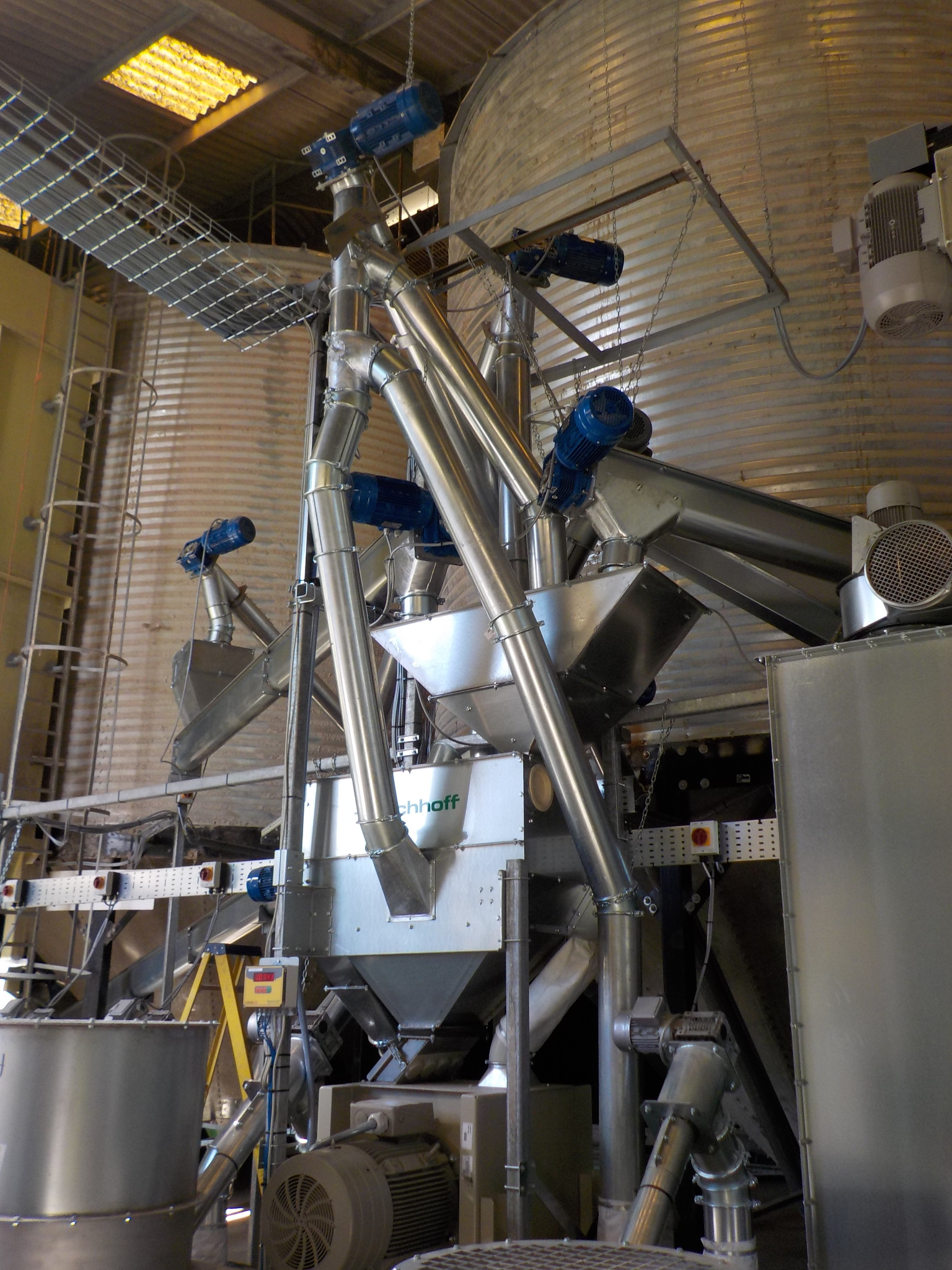
B&W Feeds supplies Buschhoff static milling and mixing systems for livestock farms and agricultural businesses.
Depending on the project, a system can incorporate elements such as ingredient intake and transfer, raw-material storage, milling, weighing and dosing, mixing, recipe management and finished-feed handling.
But the important principle comes before any individual component:
the system should be designed around the farm, rather than the farm being forced to fit a standard system.
That means understanding the ingredients, feed requirements, buildings, available space, labour and future plans before settling on a specification.
Thinking about permanent feed production?
If you are considering whether your own milling and mixing system could be appropriate, start with the business rather than an equipment list.
Useful information for an initial discussion includes:
- your location;
- livestock type or feed being produced;
- main ingredients;
- approximate annual feed requirement;
- existing buildings, silos or feed-handling equipment; and
- what you want the proposed system to achieve.
B&W Feeds can then discuss whether a permanent system is worth exploring and, where appropriate, how a Buschhoff installation could be planned around the requirements of your business.